by Ron Samul
July 2012 — Off Montauk — The Wreck of the U.S.S. Bass (Depth 160 feet)
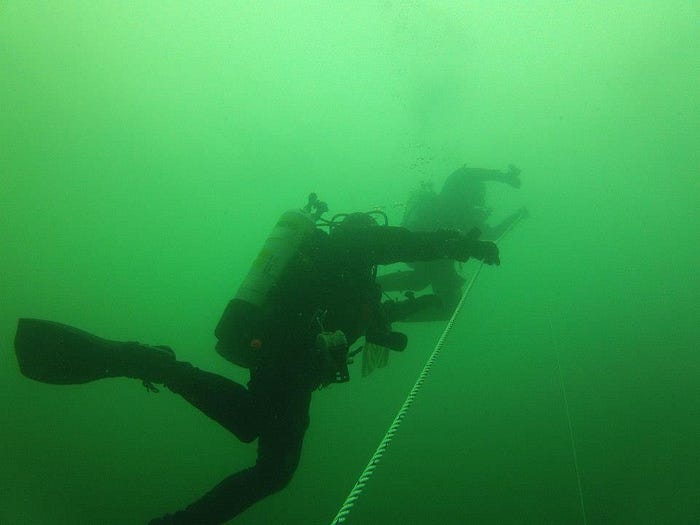
Hanging on the decompression line, I checked the valve of my dry suit and gazed down into the milky green. One hundred and sixty feet below me rested the wreck of the U.S.S. Bass—a Barracuda-class submarine, once a weapon of war, later surrendered to the sea. She was decommissioned and sunk as part of a weapons test, but down there, stripped of her former violence, she seemed more like an ancient relic, dreaming in the cold.
Adjusting to the pressure has become instinct—a ritual etched into the body after years of diving. In my first scuba course back in 1994, it was everything: the math of nitrogen absorption, the physics of ascent. Now, as I spiraled down the line, the descent felt almost ceremonial—an act of faith balanced between science and surrender.
Darkness and cold are the twin signatures of the deep. At seventy, eighty, ninety feet, the surface sun gave up its reach, and the ocean wrapped itself around me like a cathedral. I added air to the dry suit for warmth and comfort, the hiss of valves marking my passage from light into shadow. My dive light flared to life, and the world narrowed to a silver beam and the slow blur of descending bubbles.
Then, ahead, the shadow appeared—a vast presence suspended in the green. The outline of the submarine stretched before me, monumental and mournful. Even in near-darkness, her shape was clear: the rails, the conning tower, the memory of human power now quieted. Cold water shimmered around her, a molecule-thick curtain between history and rebirth.
At the anchor site, I began untying my gear, careful and deliberate. But as my hand traced the metal and rope, something inside me surged—a flash of recognition, an idea rising from the deep. Enlightenment, or perhaps the illusion of it. It came without language, without reason. Just the clarity that things, for a moment, made sense.
When the gear was free, I cut loose from the wreck and began my ascent. The anchor fell away, tumbling into the dark. Above me, sunlight pulsed through the water like a calling. “Go to the light,” I thought. And I rose.
Controlling an ascent is its own discipline—a choreography governed by physiology and patience. Decompression stops aren’t suggestions; they are laws written in blood and pressure. At sixty feet, I hovered, watching my computer, breathing steadily, the cold slowly retreating. All was in order.
Then the strange rush came—the endorphin flicker that makes you want to laugh, to shout into your regulator. I pumped my arm and exhaled a muffled cheer through the mask. I’m alive. That invincible joy filled me like helium. For the rest of my deco-stop, I hummed a rock anthem through my regulator, bubbles keeping rhythm with the beat.
At thirty feet, I calmed, checked my gear, and floated in rhythm with my computer’s ticks. At fifteen feet, sunbeams pierced through the surface and turned the water gold. The hull of the dive boat drifted above like a slow-moving cloud. I was off-gassing—shedding nitrogen, reclaiming equilibrium. Within those minutes, something settled inside me. The vision I’d felt at the bottom, that flash of meaning—it was gone now, evaporated like bubbles rising into light. Only the knowing remained: it had happened. It had meant everything and nothing. A seashell with no occupant.
Later, I read divers’ accounts describing the same sensation—depth as spell, the sea as hypnotist. Some say it’s the body adapting, others claim it’s the ocean’s way of reminding us who we were before breath and bone. Maybe both are true. Technical diving demands mastery, vigilance, and science—but beneath that precision lies myth, the ancient pull of the water calling us home.
In those depths, fear speaks quietly, and you learn to listen. Because technical diving isn’t just a sport—it’s an encounter. Between pressure and purpose, data and dream, you find the sea waiting to teach you what you were too distracted to learn on land.

